Hydrogen Network
Nordic-Baltic Hydrogen Corridor: Strong Market Support for Cross-Border Hydrogen Pipeline
- Market survey confirms NBHC as a viable and necessary EU energy corridor
- Commercial use beginning with commissioning (2033+)
- Projected market demand of 79.2 TWh along the corridor
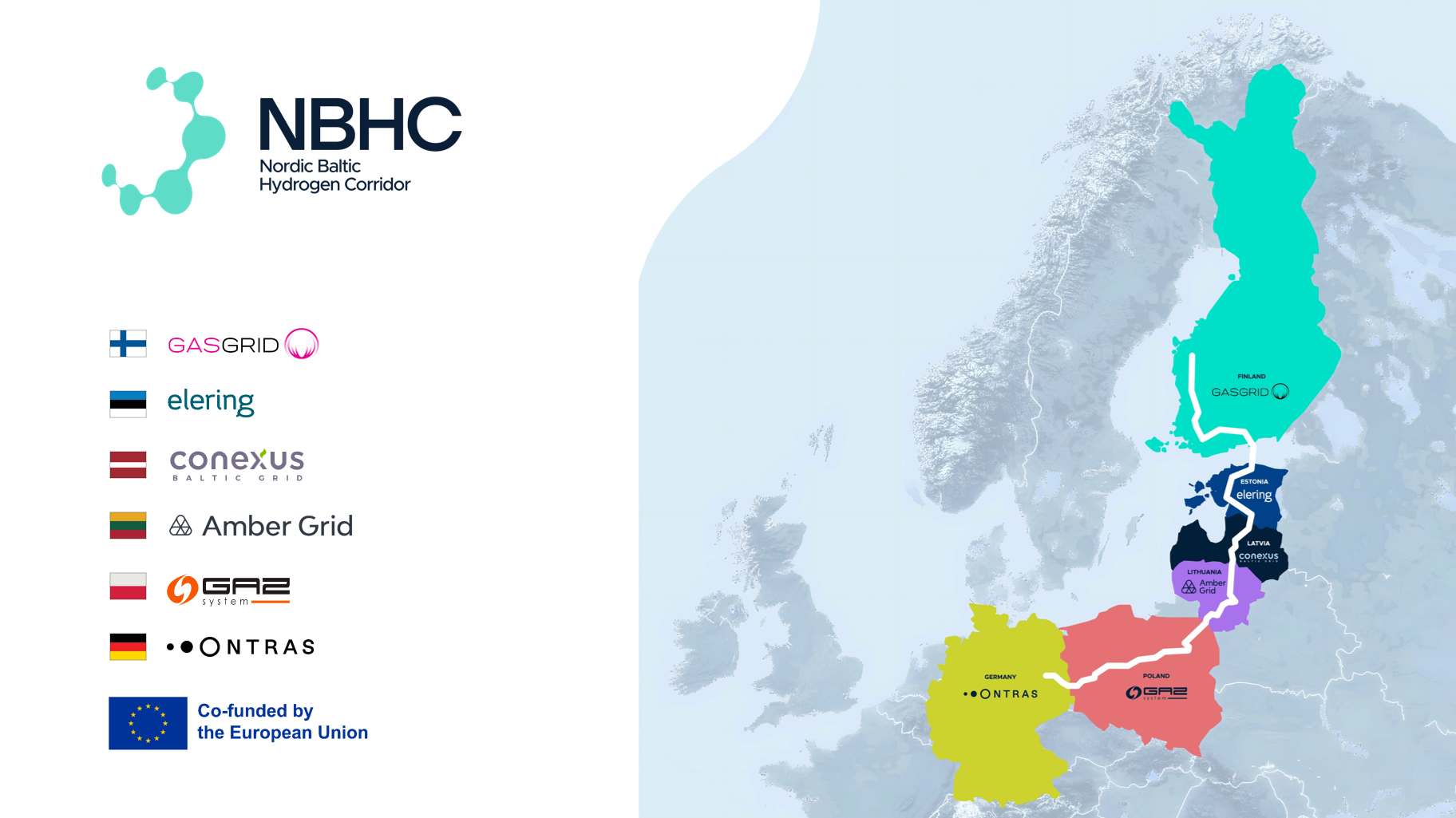
Leipzig, July 23, 2026. Capacity requirements and market demand confirm the Nordic-Baltic Hydrogen Corridor (NBHC) as a viable and necessary European energy corridor that will be commercially operational from the start of its commissioning, with a timeline beginning in 2033. This was the finding of a non-binding market consultation conducted from January to April 2026 by the participating transmission system operators (TSOs) in Finland, the Baltic states, Poland, and Germany.
The market survey collected 93 responses from 81 companies, representing a total of 108 projects across the entire value chain—production and consumption, storage and regional distribution networks, as well as cross-border transmission. The results show that the projected corridor-wide market demand could rise to 79.2 TWh per year by 2040. Of this, 64.4 TWh is attributable to industrial projects along the corridor and 14.8 TWh to German distribution grids. This corresponds to approximately 87 percent of the corridor’s theoretical capacity of 91 TWh, as determined in the preliminary feasibility study.
“The market survey confirms structural demand along the planned route, thereby underscoring the high relevance of the NBHC. Our next goal is to convert the responses to the market survey into formal letters of intent,” said Ralph Bahke, ONTRAS Managing Director of Management and Development. “At the same time, the results show that the market is still in an early stage of development. This highlights the need for effective de-risking mechanisms and a stable regulatory framework to enable investment decisions and support the gradual development of a European hydrogen market.”
Regional Supply and Demand Dynamics
Germany is the most important target market and the largest consumer in connection with the NBHC. Accordingly, consumption near the corridor is expected to nearly triple, from 15.3 TWh in 2033 to 44.4 TWh in 2050.
Poland has a dynamic market profile in which industrial demand consistently exceeds domestic production. Hydrogen production is expected to rise from 2.8 TWh in 2033 to 13.2 TWh in 2050, while demand will grow from 11.8 TWh to 32.4 TWh over the same period.
The Baltic states will be both producers and consumers in a growing regional hydrogen economy. Production is expected to grow from 3.4 TWh in 2033 to 11.1 TWh in 2050. At the same time, consumption will rise from 0.2 TWh to 4.5 TWh over the same period.
Finland plays a key role in hydrogen production. Hydrogen production is expected to rise from 15.4 TWh in 2033 to 38.6 TWh in 2050, while domestic consumption will remain largely constant at around 2.1 TWh per year.
Drivers for the broader market
The outlook for the German market is supplemented by indicative figures from the distribution system operators (DSOs). Based on data from seven DNOs focusing on eastern Germany, demand is projected to rise from 3.0 TWh in 2033 to 24.9 TWh in 2050.
Recent findings from the Germany-wide hydrogen market survey conducted for the new network development plan suggest that long-term demand projections in Germany could exceed the German demand reported in the market survey. This underscores the NBHC’s role as a key supply corridor.
The data on cross-border transportation also underscore the need for an international hydrogen pipeline. In the market survey, transport customers and traders indicated that they plan to increase their transport volumes from 25.4 TWh in 2035 to 38.2 TWh in 2050. A significant portion of these volumes remains flexible in terms of the target market. This points to the emergence of a liquid European hydrogen market in which early market participants secure transportation capacity to be able to deliver hydrogen to the most attractive sales markets.
Completion of the feasibility studies in 2027
The NBHC project is currently in the feasibility phase. The participating transmission system operators—Gasgrid (Finland), Elering (Estonia), Conexus Baltic Grid (Latvia), Amber Grid (Lithuania), GAZ-SYSTEM (Poland), and ONTRAS Gastransport—will continue their dialogue with market participants to further assess capacity requirements and potential development paths for the project. Technical, economic, and regulatory studies are currently underway and are scheduled to be completed in 2027. The project remains open to additional input and feedback from the market as planning progresses.
Read the full report on the NBHC market survey.